
What Is IRO in CSRD?
Oleksandra Kvasnytska
Sustainability Expert
Published
25 November 2026
IRO stands for impacts, risks and opportunities. In the CSRD and ESRS, it describes how a company affects people and the environment, and how sustainability matters may affect its business. Material IROs determine which sustainability topics a company must include in its reporting.
Last updated: 25 November 2026
IRO meaning in the CSRD
The Corporate Sustainability Reporting Directive (CSRD) requires companies within its scope to disclose sustainability information, while the European Sustainability Reporting Standards (ESRS) specify what and how they must report.
The term IRO appears throughout ESRS, particularly in the requirements for identifying and assessing material sustainability matters. Companies must disclose their material impacts, risks and opportunities as part of the double materiality principle. This covers both their effects on people and the environment and the financial consequences of sustainability matters for the business.
Impacts, risks and opportunities explained
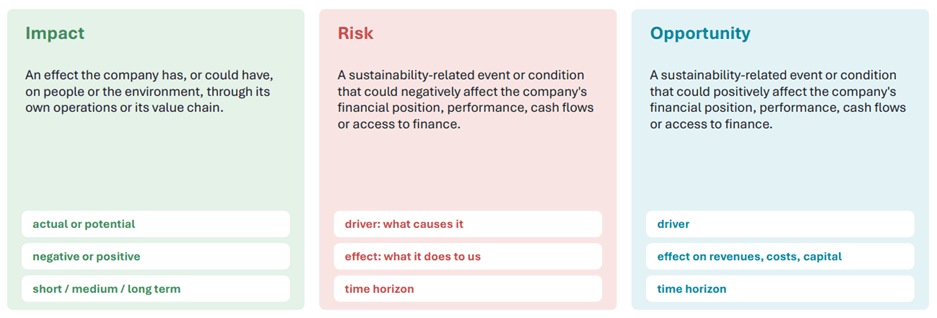
The three elements describe different aspects of the relationship between a company and sustainability matters:
- Impacts are the actual or potential effects of business activities on people and the environment. For example, a factory may affect local water quality through its wastewater.
- Risks are potential negative financial effects on the company. For example, water shortages could disrupt production and increase operating costs.
- Opportunities are potential positive financial effects. For example, investing in water-efficient technology could reduce costs and improve resource efficiency.
How IROs are identified
Companies examine their own operations, business relationships and upstream and downstream activities across the value chain to identify relevant IROs. They assess impacts based on their severity and, for potential impacts, likelihood. Risks and opportunities are evaluated based on their likelihood and potential financial significance.
This process forms part of the double materiality assessment (DMA), which determines which sustainability matters are material and must be reported under the ESRS. For more information about the key stages, considerations and practical aspects of conducting DMA, explore COVERE²'s DMA Guide.
Get in touch to discuss your goals with our experts

© 2026 COVERE². Operated by Eleks Holding OÜ, registry code 12995761, Kursi 3, 10415 Tallinn, Estonia. info@covere2.eu