
What Is Double Materiality?
Oleksandra Kvasnytska
Sustainability Expert
Published
25 November 2026
Double materiality is an approach to sustainability reporting that examines two perspectives: how a company affects people and the environment, and how sustainability matters affect its financial position and performance. It is a core principle of reporting under the CSRD.
Last updated: 25 November 2026
Double materiality meaning
The concept combines two perspectives:
- Impact materiality (inside-out): assesses a company's actual and potential positive or negative effects on people and the environment, including across its value chain.
- Financial materiality (outside-in): examines sustainability-related risks and opportunities that could affect the company's financial performance, position or cash flows.
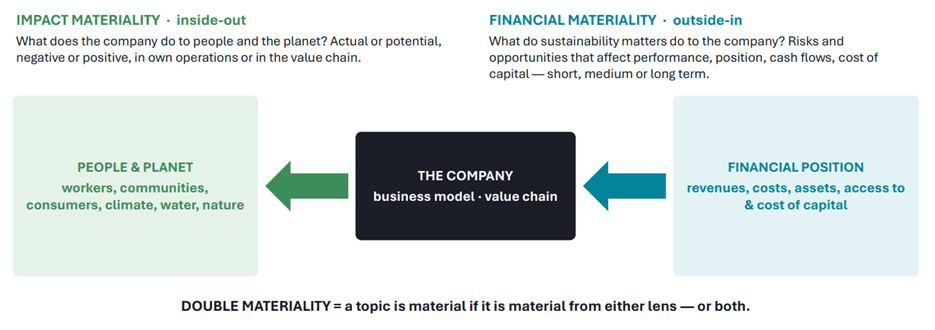
A sustainability matter is material if it meets either criterion or both. The two perspectives are connected, as environmental or social impacts may create financial risks. However, an impact can be material even if it has no significant financial effect on the company.
Double materiality under the CSRD
The CSRD requires companies in scope to apply double materiality when deciding which sustainability matters to disclose under the ESRS. This determines which information about their material impacts, risks and opportunities (IROs) must appear in sustainability statements.
The ESRS follow a double materiality approach, while the ISSB Standards focus on sustainability-related risks and opportunities that could affect a company's prospects and influence investor decisions. This is commonly described as a single, financially focused materiality perspective.
What is a double materiality assessment?
A double materiality assessment (DMA) is the process of identifying and evaluating a company's material sustainability matters. It generally involves five stages:
- Business context: understand the company's activities and business model.
- Value chain context: identify relevant upstream and downstream activities and business relationships.
- Identification: identify relevant IROs.
- Assessment: evaluate their significance from impact and financial perspectives.
- Thresholds: determine which matters are material and should be reported.
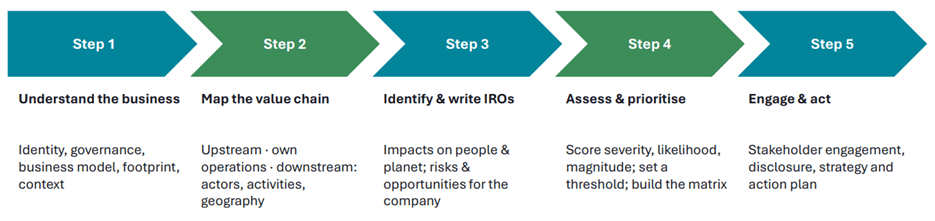
Companies may present the results in a materiality matrix. The assessment should also be reviewed when significant changes could affect its conclusions.
For further guidance on the key stages, considerations and practical aspects of conducting a double materiality assessment, explore COVERE²'s DMA Guide.
FAQ
What is the difference between single and double materiality?
Single materiality focuses on sustainability-related information that could affect a company's financial performance or prospects and influence investor decisions. Double materiality also considers the company's impacts on people and the environment, even when they do not create financial risks.
How often should double materiality be reassessed?
Companies should consider at each reporting date whether significant changes could affect previous assessment conclusions. Changes in business activities, value-chain relationships, external conditions or understanding of sustainability impacts and risks may require the assessment to be reviewed and updated.
Get in touch to discuss your goals with our experts

© 2026 COVERE². Operated by Eleks Holding OÜ, registry code 12995761, Kursi 3, 10415 Tallinn, Estonia. info@covere2.eu