
CRCF Is Changing the Carbon Credits Market
Oleksandra Kvasnytska
Market and Customer Research Specialist
Published
18 August 2026
The EU is building a new framework for a more credible carbon credits market. The Carbon Removals and Carbon Farming (CRCF) Regulation (EU) 2024/3012 introduces the first EU-wide voluntary framework for certifying permanent carbon removals, carbon storage in products, and carbon farming.
For farmers and land managers, CRCF creates a structured pathway to certify the climate benefits of activities such as agroforestry, peatland restoration, and improved agricultural practices. For companies, it offers a common EU framework for identifying and supporting certified carbon removal and carbon farming activities.
As the first certification methodologies enter into force, understanding how CRCF works is becoming increasingly important for both sides of the emerging market.
What Is CRCF and Why Does It Matter?
Until now, voluntary carbon markets have largely relied on private certification standards, with different approaches to quality, monitoring, and verification. CRCF introduces common EU rules for quantification, certification, verification, and registration.
The framework is voluntary, but CRCF certification could become an important trust signal as the market develops. This could be particularly relevant for sectors where emissions are difficult to fully avoid, including agriculture, cement, steel, aviation, and maritime transport.
For Farmers: Turning Carbon Farming into a Certifiable Climate Benefit
CRCF provides farmers, land managers, and forest owners with a pathway to have eligible carbon farming activities independently certified.
The framework covers activities including agriculture and agroforestry on mineral soils, rewetting and restoration of peatland and other organic soils, and afforestation.
To participate, operators apply through a Commission-recognised certification scheme, prepare an activity and monitoring plan, implement the relevant activity, and undergo an independent audit by a certification body. After successful verification, the activity can receive a certificate of compliance and, once results are verified, certified units.
Smaller farmers may also benefit from group certification, which can help reduce monitoring and audit costs when participating operators are geographically close, have similar conditions, and follow the same methodology.
In other words, CRCF can provide farmers with a structured way to demonstrate that their activities deliver measurable and sustainable carbon benefits – and potentially connect those benefits with demand from companies.
For Companies: A More Transparent Way to Navigate Carbon Removals
For companies looking to support carbon removals or carbon farming, one of the key challenges is assessing whether a carbon project delivers a credible climate benefit.
CRCF addresses this by establishing common EU-wide quality and certification requirements. Certified activities must meet the QU.A.L.ITY criteria (QUantification, Additionality, Liability, and SustainabilITY).
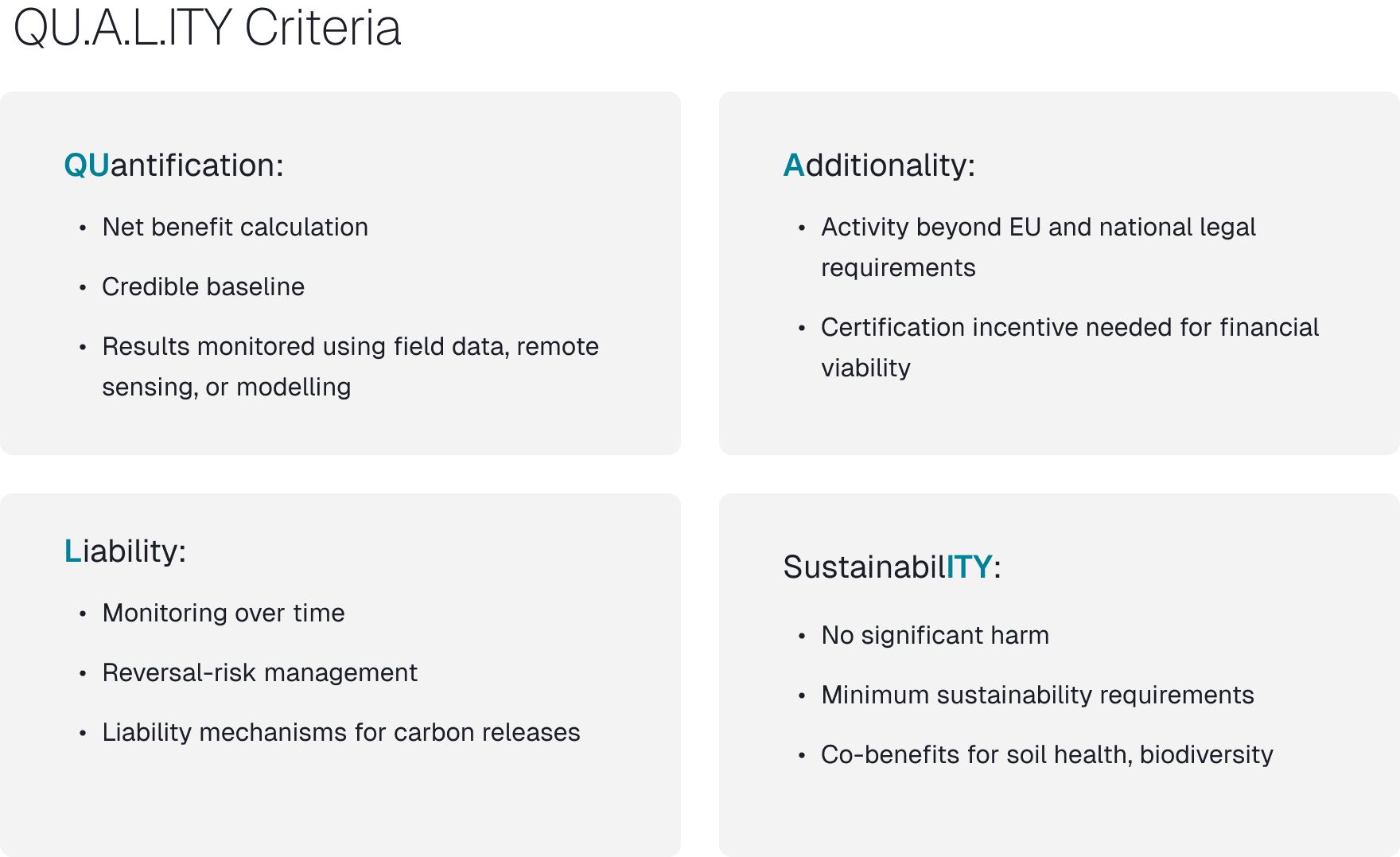
For companies, these requirements can provide a clearer basis for evaluating certified carbon units and identifying activities aligned with their voluntary climate strategies.
How Will the CRCF Market Develop?
CRCF is actively moving from regulation toward practical implementation. The Regulation entered into force in December 2024, followed by technical rules covering certification schemes, certification bodies, audits, certification documents, and registries in November 2025.
Between February and May 2026, the first methodologies for permanent carbon removals were adopted, followed by the adoption of carbon farming methodologies in July 2026.
The coming 2026-2027 period is expected to focus on the approval of certification schemes and certification of the first carbon removal units. A centralised EU registry for certified carbon removals and soil emission reductions is planned to be established in December 2028.
As the CRCF market develops, understanding the framework early can help market participants prepare for new opportunities around EU-certified carbon units.
What Does CRCF Mean for You?
CRCF is likely to become an important part of Europe's evolving voluntary carbon market. The framework is complex, with new methodologies, certification schemes, and market mechanisms emerging over the coming years.
Want the essentials without reading the full regulation?
Register on the COVERE² platform and download the CRCF one-pager for free to get a concise overview of the regulation, key timeline, QU.A.L.ITY criteria, key actors, and certification process.
Register on the platform and download the CRCF one-pager to get started.
Get in touch to discuss your goals with our experts

©2026 COVERE², All rights reserved