
What Is Carbon Neutral?
Oleksandra Kvasnytska
Sustainability Expert
Published
25 November 2026
Carbon neutral describes an organisation, product or activity whose greenhouse gas emissions have been reduced and whose remaining carbon footprint is balanced through carbon credits or other recognised offsetting over a defined period. The claim must identify its subject and the period assessed.
Last updated: 25 November 2026
What does it mean to be carbon neutral?
A carbon-neutral claim must define its subject and reporting period, specify whether it covers a business, product, service or activity, and identify the emissions assessed. Organisations should reduce emissions first, then use eligible carbon credits for residual emissions. Transparent calculations and evidence of reductions and offsetting must support the claim.
ISO 14068:2026 sets out principles for measuring, reducing and offsetting a carbon footprint. It prioritises reductions and removal enhancements before offsetting.
Carbon neutral vs net zero
Carbon neutrality and net zero are related concepts, but they differ in the level of emissions reductions required.
Carbon neutrality can be achieved by balancing a defined carbon footprint through emissions reductions and carbon credits that compensate for the remaining emissions.
Net zero requires substantial reductions across an organisation's value chain, covering direct operations and indirect emissions. Only residual emissions that cannot be eliminated are neutralised, typically through carbon removals.
This means net zero places greater emphasis on reducing emissions at source rather than relying on offsetting.
Carbon neutral claims under EU rules
From 27 September 2026, Directive (EU) 2024/825 prohibits claims that a product has a neutral, reduced or positive greenhouse gas impact when based on offsetting emissions outside its value chain. Actual lifecycle claims may still be possible if accurate and not misleading.
The Directive also restricts generic environmental claims without recognised excellent environmental performance. These restrictions aim to prevent greenwashing, where businesses use broad or misleading environmental claims that are not adequately supported by evidence.
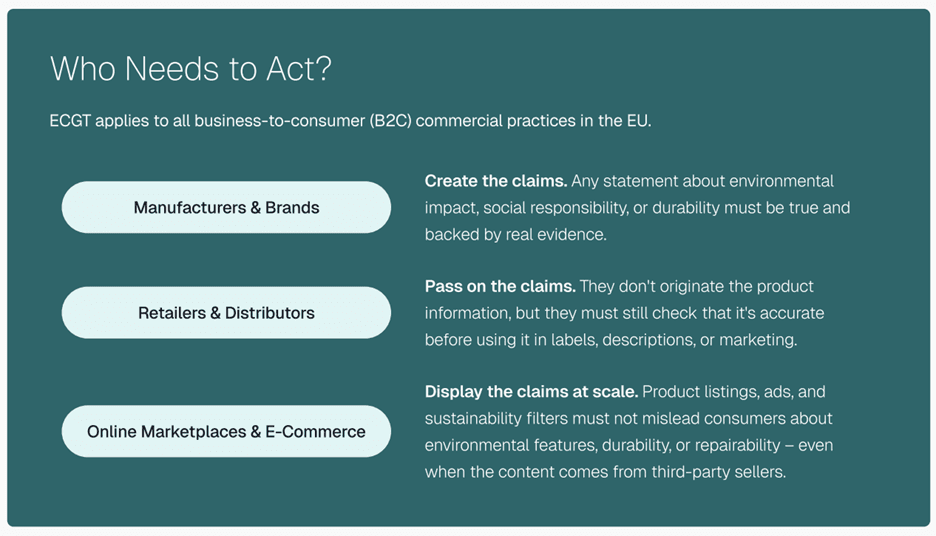
For a more detailed overview of the Directive and its implications for businesses, see our COVERE² article, Buying Green by Default: What the EU's New Public Procurement Act Means for the Environment.
FAQ
Is carbon neutral the same as zero emissions?
No. Carbon neutral does not mean that no greenhouse gases are emitted. It means emissions have been reduced and the remaining footprint balanced through eligible offsetting. Zero emissions would mean no emissions are released by the subject being assessed within that boundary.
Can a product still be marketed as carbon neutral in the EU?
Not when the claim relies on offsetting emissions outside the product’s value chain. Claims based on the product’s actual lifecycle impact may be possible, provided they are accurate, substantiated and not misleading under consumer-protection rules in force in the EU.
Get in touch to discuss your goals with our experts

© 2026 COVERE². Operated by Eleks Holding OÜ, registry code 12995761, Kursi 3, 10415 Tallinn, Estonia. info@covere2.eu