
Designing a Sustainable Future: Our User-Centred Approach for COVERE²
Marie-Lou Manca, Adam Kuras
Sustainability Expert
Published
13 June 2025
We live in an era where sustainability is no longer optional. It is essential. Businesses across sectors are increasingly recognising the importance of emissions management and integrating sustainability strategy into their operations and long-term plans.
As part of our work at ELEKS, we are contributing to this shift through the development of COVERE² - a digital solution designed to improve how organisations in the agri-food sector collect, verify, report, and ultimately reduce greenhouse gas (GHG) emissions. From the very beginning, we prioritised a User-Centred Design approach to ensure the tool reflects real operational needs and actively supports decision-making in complex environments.
Building with Purpose
The overarching objective of COVERE² is to empower organisations with a platform that enables them to act - to make informed, strategic decisions that support both environmental and economic resilience. This means developing tools that go beyond monitoring and reporting. The platform must enable users to do more than just comply - it must help them progress.
We set ourselves a few goals:
- We want to develop a comprehensive solution to support companies in their efforts to understand and reduce greenhouse gas emissions accurately.
- We want to simplify and advance complex topics such as compliance, data management, data processing, and reporting, empowering and equipping organisations to effectively contribute to achieving net zero goals.
- We want to improve sustainability data quality.
To achieve these goals, the development process had to be grounded in the experience and expectations of those who will ultimately use the platform.
Beyond technical robustness, usability, clarity, and contextual relevance are essential to ensure adoption and long-term impact.
User-centred design approach to building the COVERE² platform
Through targeted user research, we engaged a range of stakeholders across the agri-food value chain: from small-scale farmers and sustainability managers to large-scale processors and agricultural cooperatives. By conducting interviews, workflow mapping, and iterative prototyping, we were able to translate abstract sustainability requirements into tangible product features.
This process revealed a set of shared user priorities: transparency and guidance on data quality and traceability, and smooth usability. These insights play a direct roll in achieving the goal structure and flow of the digital solution - from its modular architecture to its user interface logic.
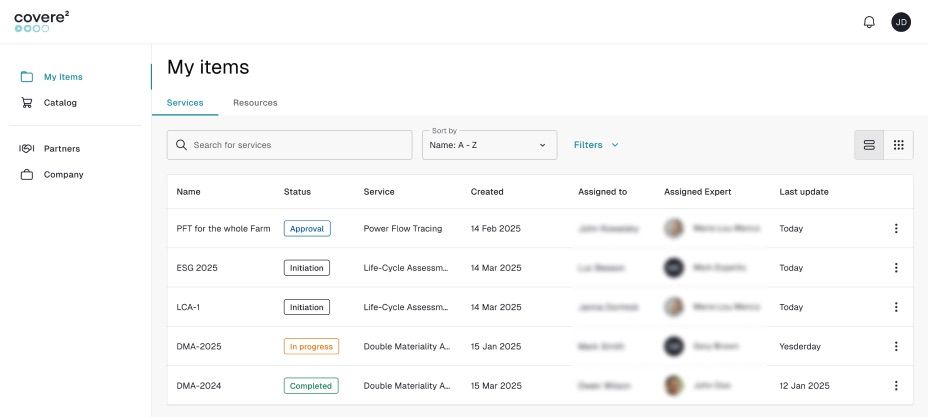 The COVERE² dashboard displays sustainability services
A Foundation for Scalable Impact
By adopting a User-Centred Design approach, we are not just building a digital product - we are shaping a catalyst for long-term change.
COVERE² is intended to
- foster transparency,
- enable credible reporting,
- and support real emissions reductions
across a sector that plays a critical role in the climate transition.
COVERE² is one example of how research-driven design can help translate climate goals into practical tools that scale. We believe that this approach - combining deep domain expertise with close user engagement - will result in a product that delivers measurable value.
As development continues, one principle remains at the core: engage users early, refine continuously, and base every decision on real-world insight or research-based insights, not the assumptions.. This is what makes a sustainability solution meaningful - for the people, for our environment, and for the organisations striving to lead responsibly.
Read the full article, including results and the key lessons on the Eleks website.
Get in touch to discuss your goals with our experts

©2026 COVERE², All rights reserved