
Building COVERE²: Behind the Scenes with Illia Chekan, Senior Project Manager
Adam Kuras
Customer Experience Lead
Published
23 December 2025
At COVERE², we believe that impactful digital products emerge where domain expertise, intentional design, and engineering excellence intersect. Our platform is built by a cross-functional team that collaborates across product management, data science, software engineering, and sustainability consulting.
Today, we sit down with Illia Chekan, Senior Product Manager at ELEKS and COVERE², who leads the development effort behind our sustainability platform that helps agri-food producers on their journey toward Net Zero.
We discussed his technical approach, agile delivery practices, and what it takes to translate complex sustainability challenges into scalable software.
Hey Illia! Let's start with a simple yet very important question. What is COVERE², and what problem does it solve?
Illia: Heya! Yeah, so COVERE² is more than just the platform, but let’s start from our product. It is a sustainability platform designed to empower our customers - especially in the dairy section in its piloting phase - in their sustainability journey.
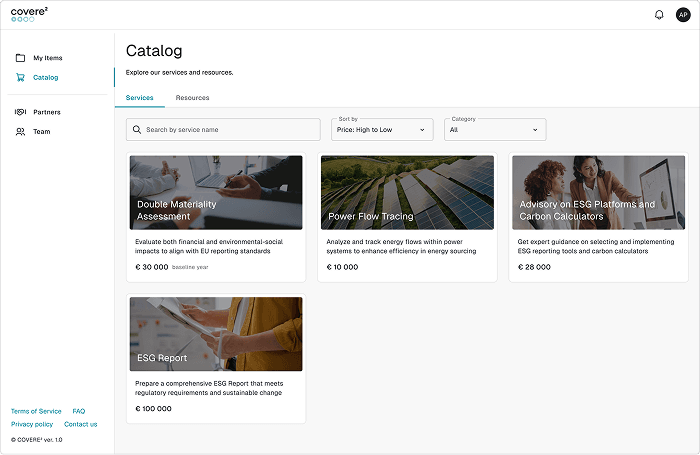
Agricultural companies face several challenges: evolving reporting frameworks, inconsistent datasets, and disconnected systems. COVERE² tackles these by offering a holistic and comprehensive set of services covering all stages of the transformation, from assessments and gap analysis to data identification, collection, platform selection, reporting, and transformation scenarios.
What are the biggest challenges you face in developing a platform like this?
Illia: From an engineering perspective, three big areas stand out:
1. Balancing innovation with platform stability
Sustainability standards, regulatory expectations evolve constantly. Our architecture needs to support quick adaptation without compromising reliability. This pushed us toward a modular, service-oriented design, allowing components to evolve independently.
2. Ensuring alignment across the team
From a project management perspective, this meant maintaining clear and continuous communication, validating assumptions early, and creating transparency around decisions and changes. Syncs, well-defined ownership, and shared documentation helped keep everyone aligned and moving in the same direction, despite the project’s complexity.
We addressed this by establishing clear hand-off practices: regular product syncs, reviews of designs, and shared ownership of requirements. This approach helped us reduce friction, avoid sudden changes, and keep the team aligned.
3. Technology Stack shift
As we were developing a product in quite a dynamic environment and the more we knew and understood about the market, regulations and user behavioral patterns - the more complex the business logic became.
At one point we realized that in order to provide stable solution that will be able to scale up to upcoming challenges - we had to switch the technology stack as well as data processing, handling and storing approaches.
It never comes as an easy decision as it involves a lot of reengineering and even more testing without any significant visual changes, as all of those happen under the hood, but that certainly was the right decision to make.
4. Third-party solutions integration
If you want the solution to be as efficient as possible for the use case that you have - you will have to build everything from scratch with as little overhead as possible. As great as it is in it's value, it often means a lot of time and effort for engineering and development.
That's why we've made a decision to utilize several third-party solutions and services to do the heavy lifting in such areas as event scheduling or payment processing. However those decisions always come with a challenge of working around the provided functionality to make it work just like you would love it to.
Your role sounds central to connecting business goals with engineering. How would you describe it?
Illia: As Senior Project Manager, I am responsible for the technical execution. My role is to ensure that everything we build in COVERE² is aligned with the outcomes from our research, discovery and design. That means deep cooperation with engineering, design, and QA teams.
My responsibility is to ensure that every sprint delivers real user value, not just features. That means working deeply with:
- Sustainability consultants to define valuable areas and the functionality they comprise,
- Business Analyst to discuss technical requirements,
- Designers to clarify user journeys and friction points,
- Engineers to translate domain logic into scalable, testable functionality.
How do you collaborate with the engineering team to make that vision a reality?
Illia: We believe in early collaboration. Engineers are part of customer research activities, including usability testing sessions - not just development sprints. When they understand why we’re building something, they often propose smarter, more scalable technical solutions.
We follow an Agile approach with a strong emphasis on early involvement and continuous discovery and improvement. Engineers join discovery, not only development. This gives them context behind the “why,” often leading to more elegant architectural proposals than what we initially imagined.
A sprint process built around transparency. Our Agile delivery rhythm relies on:
- Short, focused sprints
- Regular demos to consortium partners
- Definition of Done tied to user outcomes, not story points
- Technical spikes when exploring unfamiliar sustainability methodologies
We never ask, “Did we just ship it?” but instead, “Does this increment move producers closer to measurable emissions reduction?”
Can you share a recent example where the team solved a challenge creatively?
Illia: During our development process, we hit a scalability bottleneck: the volume and frequency of sensor data pushed our initial architecture to its limits. The engineering team proposed a shift to a modular refactor. This decoupling significantly improved performance, reduce our technology debt.
What makes a strong product team, in your view?
Illia: Trust and shared ownership. When every team member - from developers to designers to domain experts - feels accountable for the outcome, not just their piece of work, the product becomes stronger.
We encourage open feedback loops and cross-disciplinary collaboration. During COVERE² pilot phase, we invited real users and researchers to test features early and shape the roadmap. Those insights were invaluable.
And finally, clarity. A strong team understands not just what we’re building, but why - how each decision contributes to the broader sustainability mission.
What’s your favourite stage in the product journey?
Illia: There are two. First, the discovery phase - those messy whiteboard sessions where ideas start taking shape, when creativity and problem-solving meet.
Second, seeing users benefit. When a dairy producer says, “This helped us trace our energy use and reduce emissions,” it’s incredibly rewarding. You see that the work has real-world impact - not just for a business, but for the planet.
How do you measure success for COVERE²?
Illia: We track both quantitative and qualitative outcomes and our Sustainability Consultant, Experience Designer, who helped us with qualitative research, also contributes to this part. It is crucial to make sure, we evaluate our work and connect with real users to define pain points and improve our product.
Now, to be more specific:
Quantitatively, we measure adoption rate, user engagement, reporting accuracy, and time saved. We also track the number of integrations and emissions data sources onboarded.
Qualitatively, we look at user satisfaction, feedback from pilot farms, and whether the platform truly changes operational behaviour - for example, shifting energy sourcing to greener alternatives.
What’s next for COVERE²?
Illia: We’re entering an exciting phase. Our next steps include expanding integration capabilities, strengthening the analytics and forecasting engine, and enhancing Services. We are going to start new projects that will require kind of a different approach. I am pretty sure we will share more details about it soon.
We’re also evolving the UX - improving the platform after evaluation, adding scenarios, features and preparing for potential scalability beyond dairy into other agri-food segments.
What advice would you give to teams building complex digital products?
Illia: Start with empathy. Make sure you all understand your users deeply before you start building.
Build iteratively. Don’t wait for perfection; deliver value early, learn fast, and adapt.
Communicate relentlessly, because alignment across teams is everything.
And, perhaps most importantly, design for flexibility. In fast-evolving fields like sustainability and data analytics, your product will need to adapt. The only constant is change.
Thank you for this conversation! Any final words for our readers?
Illia: Well, thank you for the conversation. It’s been great sharing our journey.
And to all our blog readers: best regards from the COVERE² team - keep innovating, stay curious, and don’t forget that even small steps can lead to big change!
Get in touch to discuss your goals with our experts

©2026 COVERE², All rights reserved